


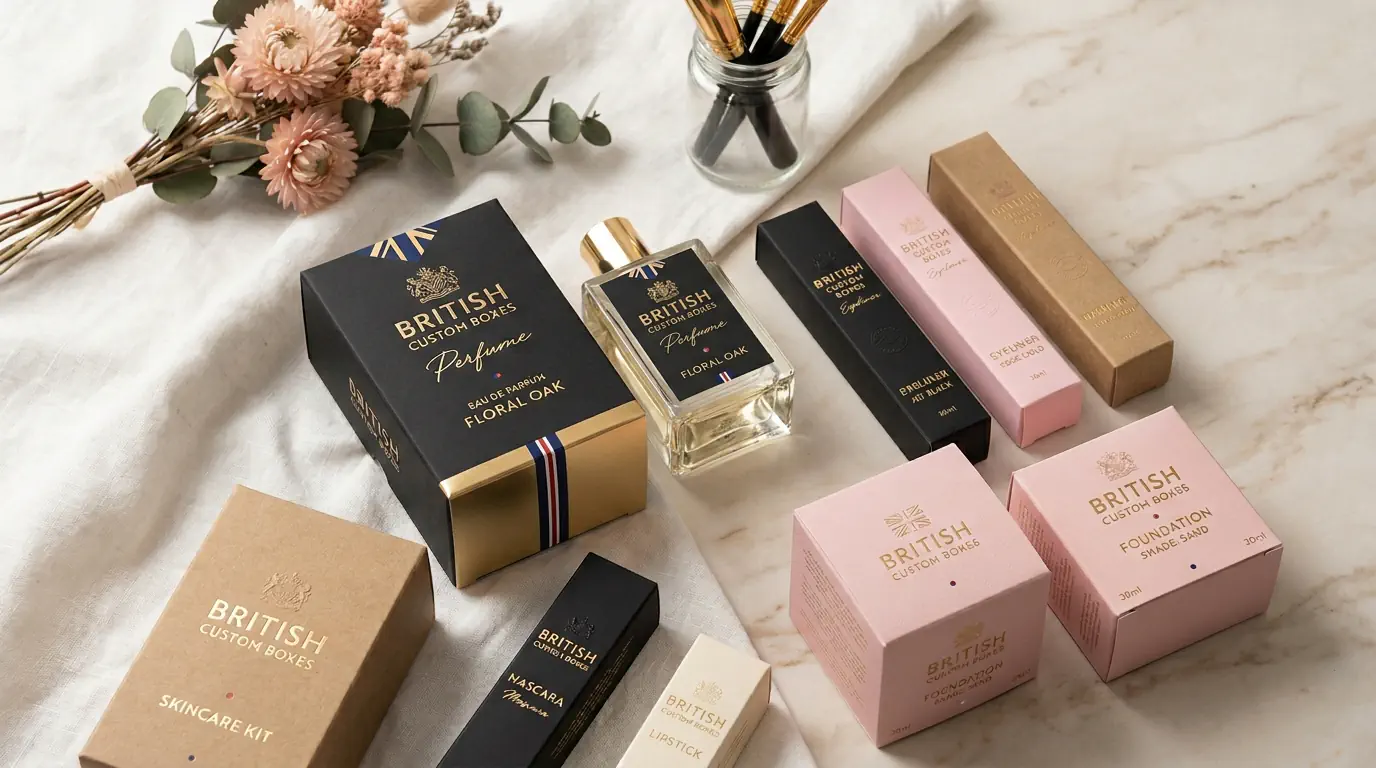
Cosmetics packaging is one of the most important decisions a beauty brand makes. It protects the product, communicates your brand story, and — in the UK — must meet strict legal labelling requirements. Yet for many brands, choosing the right packaging feels overwhelming.
This guide covers everything you need to know: the different types of cosmetic boxes, which materials work best for which products, what the law says about labelling, how to make your packaging more sustainable, and how to place your first order in the UK — with no minimum order quantity (MOQ).
Whether you’re launching your first beauty product or scaling an established brand, this is the only cosmetics packaging reference you’ll need.
What Is Cosmetics Packaging?
Cosmetics packaging is every container, box, and wrapper that holds a beauty product. It does three big jobs at once: it protects the product, communicates the brand, and keeps shoppers informed through labelling.
For any beauty brand selling in the UK, your packaging is often the very first thing a customer sees. Before they smell your perfume or try your serum, they judge the box. Studies consistently show that packaging shapes buying decisions — whether you sell through a retailer, an e-commerce store, or a subscription box.
Primary, Secondary, and Tertiary Packaging — What’s the Difference?
| Level | What It Is | Examples | Who Sees It |
| Primary | Direct product contact | Glass serum bottle, lipstick case, compact pan, pump bottle | End consumer — up close |
| Secondary | Outer box or carton | Printed cardboard box, rigid gift box, sleeve carton | Shelf browsers, online shoppers, gift recipients |
| Tertiary | Bulk shipping & transit | Corrugated shipper box, pallet wrap, transit carton | Warehouse staff and delivery teams |
For most beauty brands, secondary packaging is where the biggest design and branding opportunity lives. It’s what sits on a retailer’s shelf, arrives through a customer’s letterbox, and gets unwrapped on a TikTok unboxing video. It’s also what UK law covers most thoroughly in terms of labelling requirements — which we cover in detail in Section 5.
Types of Cosmetic Packaging Boxes
Not all cosmetic boxes are built the same. The shape and structure of your box affects how it looks on a shelf, how well it protects the product inside, and how much it costs to produce. Here’s a plain-English rundown of the most common types — and what each one works best for.
Tuck-End Boxes (Straight Tuck & Reverse Tuck)
These are the most common cosmetic box styles. The top and bottom flaps fold and tuck in — either in the same direction (straight tuck) or opposite directions (reverse tuck). They’re affordable, easy to assemble, and work brilliantly for products like eyeliner boxes, mascara, foundation cartons, and lip products.
Rigid Boxes (Magnetic Closure & Lid-and-Base)
Rigid boxes are made from thick greyboard covered in printed paper or fabric. They feel sturdy and premium. The magnetic closure style is especially popular in the luxury end of the cosmetics market. If you’re packaging a signature perfume or a high-end skincare gift set, a rigid box sends an immediate quality signal.
Drawer (Slider) Boxes
Drawer boxes have an inner tray that slides out of an outer sleeve, like a matchbox. They’re excellent for makeup kits, eyeshadow palettes, and multi-product gift sets. The sliding action makes the unboxing feel considered and premium — which matters enormously for brands that rely on social media sharing.
Sleeve and Tray Boxes
A printed outer sleeve wraps around a simple inner tray. This is a cost-effective way to add branding to a plain tray box. Many skincare brands use sleeve-and-tray combinations for subscription deliveries and seasonal gift sets.
Display Boxes (Counter Display Units / CDUs)
Custom display boxes sit on a retail shelf or counter and hold multiple units of a product. They’re great for lip balms, nail polishes, and smaller impulse-buy cosmetics. A well-designed CDU can significantly increase the number of units a retailer orders from you.
Shoulder Boxes and Two-Piece Boxes
Two-piece boxes have a separate lid and base. The shoulder-box version adds a decorative band between lid and base, giving the box a jewellery-case quality. These are often used for high-end fragrances, premium skincare serums, and cosmetic gift sets.
“Your box style should match where your product sits in the market. A budget-friendly cleanser deserves clean, efficient folding carton packaging. A £120 face oil deserves a rigid box that makes the unboxing feel like a ritual.”
| Box Style | Best For | Price Tier | Production Speed |
| Tuck-end carton | Foundations, eyeliners, mascaras, lip products | Budget–Mid | Fastest |
| Rigid magnetic box | Perfumes, luxury serums, premium gift sets | Premium | Moderate |
| Drawer / slider | Makeup kits, eyeshadow palettes, multi-item sets | Mid–Premium | Moderate |
| Sleeve & tray | Subscription boxes, skincare sets, seasonal gifts | Mid | Moderate–Fast |
| Counter display unit | Retail lip balms, nail polishes, impulse products | Mid | Moderate |
| Two-piece/shoulder | Luxury fragrances, facial oils, and high-end skincare | Premium | Slow (most premium) |
Our cosmetic packaging products:
- Custom Perfume Boxes — Luxury rigid and folding carton boxes for fragrance brands
- Custom Eyeliner Boxes — Sleek, precise packaging for pencil, liquid, and gel eyeliner
- Custom Foundation Boxes — Clean, professional cartons for pump, bottle, and compact foundations
- Custom Oil Boxes — Protective boxes for serums, facial oils, hair treatments, and essential oils
Cosmetic Packaging Materials
The material your box is made from affects how it looks, how it feels in a customer’s hand, how well it protects the product, and how much it costs.
Folding Boxboard (FBB)
Folding boxboard is the most widely used material for cosmetic cartons. It combines good printability with a clean, bright white surface. It’s what you’ll find on the packaging of most high street beauty and skincare products. Standard weights range from 300gsm to 450gsm — the heavier the board, the stiffer and more premium the box feels.
Solid Bleached Sulphate (SBS Board)
SBS board has a particularly bright, smooth white finish on both sides, which makes colours appear more vivid. It’s the material of choice for luxury skincare brands and premium cosmetics. SBS is also food-safe, which matters for lip products that may come into contact with skin.
Kraft Board
Kraft board has a natural brown, recycled look. It’s very popular with organic skincare brands and natural beauty ranges that want to signal eco-credentials through their packaging. Kraft prints well in dark inks, but bright colours can look duller because of the board’s natural colour.
Rigid Greyboard
Greyboard is the thick, dense board used to make rigid boxes. It doesn’t fold — it’s cut and glued into a solid structure, then covered in a printed wrap. The result is the kind of solid, weighty box that makes a perfume or a luxury face cream feel genuinely special.
Corrugated Board
Corrugated board is used mainly for transit and e-commerce packaging. If you’re shipping cosmetics directly to consumers, corrugated outer shipper boxes protect against knocks and drops during courier delivery.
| Material | Best For | Eco Status | Price Level |
| Folding Boxboard (FBB) | Mainstream cosmetic cartons, mass-market beauty | Recyclable | Budget–Mid |
| SBS Board | Premium skincare, luxury cosmetics, lip products | Recyclable | Mid–Premium |
| Kraft Board | Organic, natural, eco beauty brands | Recyclable + biodegradable | Budget–Mid |
| Rigid Greyboard | Luxury rigid boxes, gift sets, premium fragrances | Recyclable (with wrap) | Premium |
| Corrugated Board | E-commerce outer boxes, subscription deliveries | Highly recyclable | Budget–Mid |
For products like facial oils, serums, and hair treatment oils, material selection is especially important — the box needs to protect against moisture and light. Our custom oil boxes are designed with these requirements in mind, available in cardboard, kraft, and rigid options.
Print Finishes for Cosmetic Boxes
The finish on your cosmetic box is what turns a printed carton into something that feels genuinely considered. A good finish can make a £5 product feel like it’s worth £30, or make a £60 serum feel worth every penny.
Gloss Lamination
Gloss lamination covers the entire box in a thin, shiny plastic film. It makes colours look bright and vivid, and gives the surface a wet look that catches light. It’s the most common finish for mainstream cosmetics — affordable and eye-catching on shelf.
Matte Lamination
Matte lamination gives the box a flat, non-reflective surface. It feels more sophisticated and modern than gloss, and it photographs very well — which matters enormously in an era of social media and flat-lay product shots. A popular choice for skincare brands with a clean, clinical aesthetic.
Soft-Touch Lamination
Soft-touch — sometimes called velvet lamination — goes one step further than matte. Run your finger over a soft-touch box, and it feels almost like skin. It’s one of the most tactile, memorable finishes available, and it’s strongly associated with premium beauty. For a luxury perfume box or a high-end face oil, soft-touch lamination is often the difference between a box that feels special and one that doesn’t.
Hot Foil Stamping
Hot foil stamping presses a metallic or holographic film onto a specific area of the box using heat and pressure. Gold and silver are the classics. Rose gold is hugely popular in beauty right now. Holographic foils give a prismatic, iridescent effect. Foil stamping works in even small doses — a foiled logo on a matte box can look extraordinarily refined.
Embossing and Debossing
Embossing raises a design element above the surface of the box. Debossing presses it into the surface. Both create a three-dimensional, tactile effect that’s particularly powerful for brand marks and product names. These finishes are invisible in photography but make a big impression in person.
Spot UV Coating
Spot UV applies a high-gloss, transparent coating to specific areas of a matte surface. Imagine a matte black box with a glossy, gleaming logo — that contrast is created with spot UV. It works particularly well on foundation packaging boxes and eyeliner product packaging where a strong brand mark is central to the design.
| Finish | Effect | Best Used On | Cost Level |
| Gloss lamination | Shiny, vivid, reflective | Mass-market cosmetics, bold colour brands | Low |
| Matte lamination | Flat, sophisticated, photo-friendly | Skincare, clean beauty, minimalist brands | Low–Mid |
| Soft-touch / velvet | Tactile, velvety, luxury feel | Premium perfumes, serums, gift sets | Mid |
| Hot foil stamping | Metallic shine on specific areas | Logos, brand names, decorative accents | Mid–High |
| Embossing / debossing | 3D tactile depth on logo or pattern | Brand marks, premium skincare | Mid–High |
| Spot UV | Gloss-on-matte contrast highlight | Logos on matte or dark backgrounds | Mid |
UK Cosmetics Packaging Regulations
Cosmetics packaging in the UK is governed by specific legal requirements. Since Brexit, the UK has its own regulatory framework — separate from the EU — and it’s your responsibility as a brand to make sure your packaging complies. Getting this wrong can mean products being pulled from sale or serious legal consequences.
What Must Be on Your Cosmetics Packaging?
UK law (based on the retained EU Cosmetics Regulation 1223/2009) sets out eight pieces of information that must appear on your cosmetic packaging:
The INCI Ingredient List
The full ingredient list must use INCI names — the International Nomenclature of Cosmetic Ingredients. These are standardised Latin or English names for each ingredient, listed in descending order of weight (highest concentration first). Ingredients at or below 1% concentration can be listed in any order after the above-1% ingredients.
Post-Brexit: UKCA vs CE Marking
Since the UK left the EU, cosmetics placed on the UK market no longer use the CE mark for regulatory compliance. The UK has its own framework under the UK Cosmetics Regulation. If you’re also selling into the EU, you’ll need to meet EU requirements separately, including having an EU Responsible Person.
EPR for Packaging — What Beauty Brands Need to Know in 2025
Extended Producer Responsibility (EPR) for packaging is the biggest regulatory change affecting UK brands in years. From April 2025, businesses that place packaging on the UK market are required to register, report on their packaging data, and pay fees that fund household recycling.
| Business Size | Annual Turnover | Packaging Handled | EPR Obligation |
| Large | £2M+ | 50+ tonnes/year | Full registration, reporting, and fees |
| Small | £1M–£2M | 25–50 tonnes/year | Registration and reporting (reduced fees) |
| Micro / Exempt | Under £1M | Under 25 tonnes/year | No obligation (but worth recording data) |
OPRL Recycling Labelling — Mandatory from 2027
The On-Pack Recycling Label (OPRL) system will become mandatory for UK packaged goods from March 2027. Your cosmetic boxes will need to carry clear “Recycle” or “Don’t Recycle” labelling in a standardised format. Starting to plan for this now puts your brand ahead of the curve and avoids a rushed redesign later.
Sustainable Cosmetics Packaging
Sustainable packaging has moved from a nice-to-have to a genuine commercial necessity. UK consumers are increasingly choosing brands that take sustainability seriously — and retailers are starting to ask suppliers about their packaging’s environmental credentials as part of their buying criteria.
FSC Certification — What It Means and Why It Matters
FSC stands for the Forest Stewardship Council. When a box carries the FSC logo, it means the paper or board it’s made from comes from forests that are managed to strict environmental and social standards. For cosmetic brands making a sustainability claim, specifying FSC-certified board is one of the clearest, most credible things you can do.
PCR Materials (Post-Consumer Recycled)
PCR refers to materials that contain recycled content from products that consumers have already used and recycled. Specifying a percentage of PCR content in your packaging reduces demand for virgin materials and makes your packaging part of the circular economy story that beauty consumers and retailers respond to strongly.
Biodegradable and Compostable Options
Truly biodegradable packaging breaks down naturally over time. Some kraft and uncoated cardboard options will biodegrade in home composting conditions. Be careful with this claim, though — not all packaging labelled “eco” is certified biodegradable. If you’re making this claim, you need evidence to back it up, or you risk falling foul of the UK’s Green Claims Code.
Soy-Based Inks
Traditional printing inks use petroleum-based solvents. Soy-based inks are made from soybean oil — a renewable resource — and produce fewer volatile organic compounds during printing. Swapping to soy-based inks is one of the simplest, lowest-cost sustainability improvements you can make, with no visible difference in quality.
Avoiding Unnecessary Mixed Materials
A cardboard box with a plastic window, a metallic laminate that can’t be separated, or a box with a foam insert that has to be removed — all of these reduce recyclability. Keeping your packaging as mono-material as possible makes a real difference to your EPR fees and your brand’s genuine environmental impact.
Our custom cosmetics packaging is available in FSC-certified board, kraft, and PCR options — all designed with OPRL recycling labelling in mind.
Designing Cosmetic Packaging That Sells
Great cosmetic packaging design isn’t just about looking good. It’s about communicating the right things to the right people, in the right amount of time. A shopper in a beauty aisle gives a box about three seconds of attention before moving on. Here’s how to make those three seconds count.
The Three-Second Shelf Test
Squint at your packaging design from a distance. Can you tell: (1) what the product does, (2) what brand it is, and (3) whether it looks like something worth picking up? If any of those three things aren’t immediately clear, the design needs work.
Match Your Packaging to Your Price Point
Packaging that looks more expensive than the product’s price creates positive surprise. Packaging that looks cheaper than the product’s price creates doubt. A £30 eye serum in a matte, embossed box feels like it’s worth the money. The same product in a plain white tuck-end box feels overpriced.
Colour Psychology in Cosmetic Packaging
- White and pale tones — clean, clinical, trustworthy; popular in skincare and anti-ageing
- Black and deep charcoal — powerful, luxurious, genderless; used by premium and unisex lines
- Pastels (blush, lavender, sage) — soft, gentle, self-care; works well for bath, body, and wellness brands
- Gold and bronze — opulence and ritual; used by luxury fragrances and prestige skincare
- Kraft brown — natural, honest, eco-conscious; favoured by organic and independent beauty brands
- Bold, saturated colour — energetic, playful, fun; popular in colour cosmetics and Gen Z-targeted brands
Design for Unboxing — Because Your Customers Are Content Creators
Social media has transformed what cosmetic packaging needs to do. A growing number of your customers will film or photograph their unboxing experience. That means the inside of your box matters as much as the outside. A printed interior, a tissue wrap, a personal thank-you card, or a beautifully designed inner flap all add to the moment — and give people something worth sharing.
For brands using oil, serum, or foundation packaging, an inner tray or foam insert that holds the product securely also eliminates the worst unboxing outcome: a broken bottle rolling around in an empty box.
Typography and Logo Placement
Keep your type hierarchy simple: a dominant brand name, a clear product name, and small-but-legible legal text. Leave breathing room around your logo. For the legal information required on cosmetics boxes, choose a font size that’s genuinely readable — 6pt is the legal minimum, but 7–8pt is significantly easier for most people to read.
QR Codes: A Smart Addition to Cosmetic Packaging
QR codes on packaging are increasingly common in cosmetics — used to link to full ingredient glossaries, tutorial videos, recycling instructions, or loyalty programmes. A QR code is also a practical solution when you have a long ingredient list that won’t fit neatly on a small carton.
How to Order Custom Cosmetic Packaging in the UK
Ordering custom box packaging for the first time can feel complicated. It doesn’t have to be. Here’s the process we use at British Custom Boxes — designed to be as straightforward as possible for beauty brands, whether you’re launching your first product or reordering your 50th.
Step-by-Step Ordering Process
- Choose Your Box Type and Size
Start by browsing our custom cosmetics packaging range — from tuck-end cartons to rigid gift boxes. If you know your product dimensions, we can recommend the right box structure and size. If you don’t, send us a sample of the product and we’ll measure it for you.
- Get a Free Quote
Tell us your box type, approximate dimensions, quantity, and any finishes you’re interested in. We’ll come back with a clear price — no hidden costs, no setup fees. If you’re comparing suppliers, we’ll beat any genuine like-for-like quote.
- Design Your Artwork (Or Let Us Help)
If you have a designer, we’ll supply a dieline template for your chosen box — a PDF or AI file that shows exactly where your artwork needs to sit, including bleed areas, fold lines, and safe zones. If you don’t have a designer, our in-house team can create the artwork from your brand guidelines, free of charge.
- Approve Your Proof
Before we print anything, we’ll send you a digital proof showing exactly how your box will look. For new customers or complex designs, we’d always recommend ordering a physical pre-production sample — so you can check colour, material, and finish in person before we produce the full run.
- Production and Delivery
Once you’ve approved the proof, we go to production. Most cosmetic box orders are completed within 8–10 working days. We deliver across the UK, with shipping included. All boxes are carefully packed to arrive in perfect condition.
What About Minimum Order Quantities?
At British Custom Boxes, we operate with no minimum order quantity (no MOQ). That means you can order a single box or 100,000 — the choice is yours. This is particularly valuable for beauty brands in the early stages of a launch, when you might only need a few hundred boxes to test the market before committing to a larger production run.
How to Brief Your Supplier — 7 Things to Always Specify
- Box style — tuck-end, rigid, drawer, sleeve, etc.
- Internal dimensions — the size of the product going inside the box (L × W × H in millimetres)
- Board weight / material — e.g., 400gsm SBS, or FSC kraft
- Printing specification — full colour (CMYK), Pantone spot colours, or white ink on kraft
- Finish — matte, gloss, soft-touch, spot UV, foil, emboss, or combination
- Quantity — your required number of boxes, plus any planned reorder frequency
- Deadline — the date you need the boxes delivered, working backwards from your launch or restock date
Frequently Asked Questions
What is the difference between primary, secondary, and tertiary cosmetics packaging?
Primary packaging touches the product directly — for example, a lipstick bullet, serum bottle, or foundation pump. Secondary packaging is the outer box or carton. Tertiary packaging covers bulk transit packaging, like corrugated shipper boxes and pallet wrap used during logistics.
What must be printed on cosmetics packaging in the UK?
UK law requires eight pieces of information: (1) Name and address of the UK Responsible Person, (2) the product’s weight or volume, (3) a best-before date if shelf life is 30 months or less, (4) a PAO symbol if shelf life is over 30 months, (5) any safety warnings, (6) a batch number, (7) country of origin if manufactured outside the UK, and (8) the product’s function if it’s not obvious. You’ll also need a full INCI ingredient list.
What is the minimum order quantity for custom cosmetic boxes in the UK?
At British Custom Boxes, we have no minimum order quantity (no MOQ). You can order as few or as many boxes as you need. This is ideal for beauty brands launching new products, running limited editions, or testing different packaging designs.
What are the best eco-friendly cosmetic packaging materials?
The most sustainable options are FSC-certified cardboard, kraft board, and post-consumer recycled (PCR) materials. Choosing mono-material packaging (avoiding plastic windows in card boxes) also makes the box easier to recycle. Soy-based inks further reduce environmental impact without affecting print quality.
What does EPR for packaging mean for UK beauty brands?
EPR (Extended Producer Responsibility) is a UK regulation from 2025. It requires businesses that place packaging on the UK market to register, report, and contribute financially to recycling infrastructure. Businesses with a turnover under £1 million and handling less than 25 tonnes of packaging per year are currently exempt.
How long does it take to produce custom cosmetic boxes?
At British Custom Boxes, most orders are completed within 8–10 working days from artwork approval. If you need a physical pre-production sample before the full run, factor in an additional few days. Get in touch with your deadlines in mind — especially ahead of product launches or retailer delivery windows.
What print finish is best for luxury cosmetic packaging?
The most effective combinations for luxury cosmetics are: soft-touch matte lamination with hot gold or silver foil stamping, or matte lamination with spot UV on the logo. These create the tactile and visual contrast that consumers associate with premium beauty products. Embossing or debossing a brand mark adds a further layer of perceived quality.