


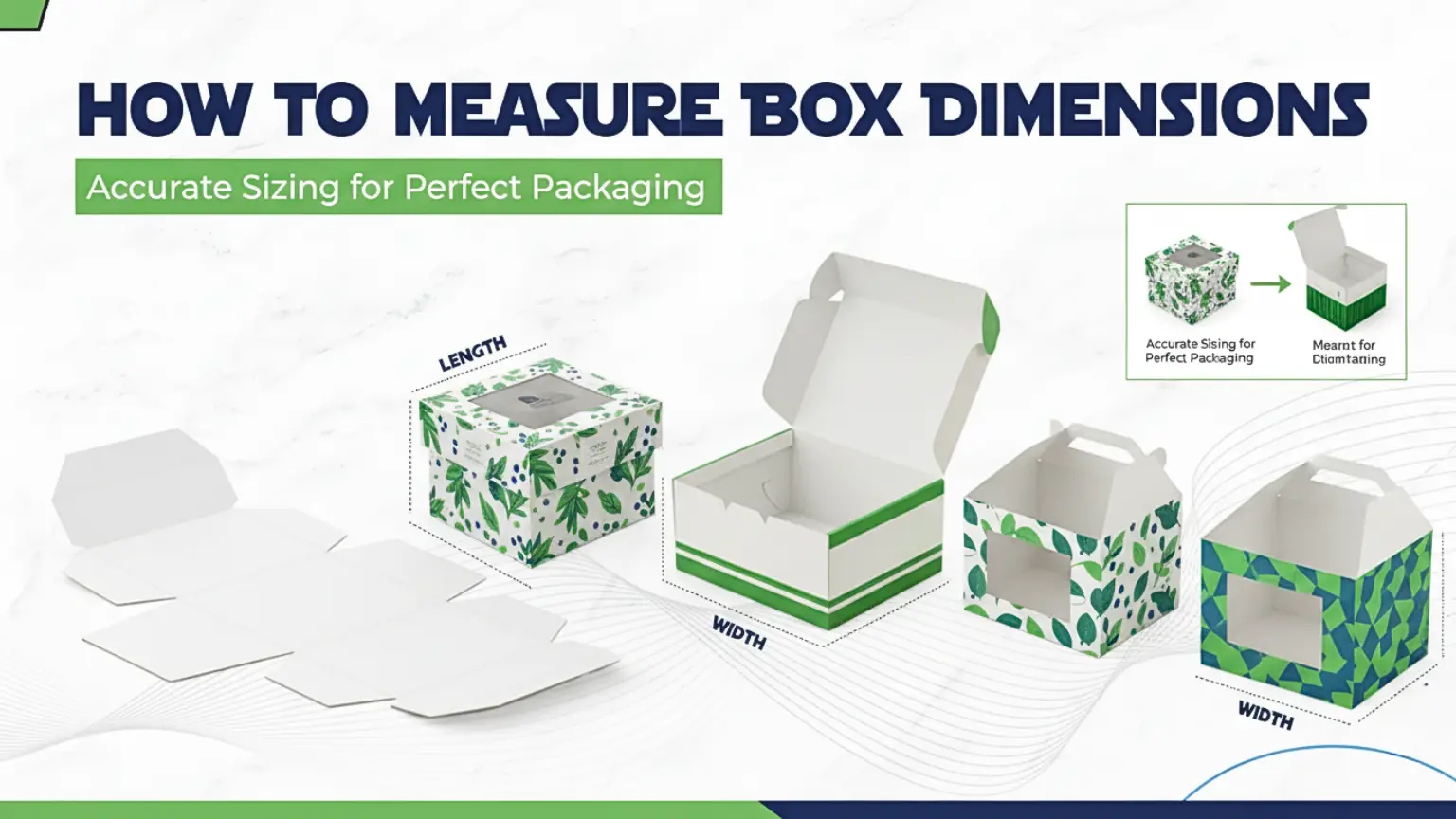
Measuring a box sounds simple—until you get hit with a courier surcharge, your item doesn’t fit, or you order packaging that’s the wrong size. This UK guide shows you exactly how to measure box dimensions (L × W × H), when to use internal vs external measurements, and how to avoid common mistakes—especially for Royal Mail and UK courier shipping.
What are the box dimensions?
Box dimensions are usually written as:
Length × Width × Height (L × W × H)
- Length (L): the longest side of the box opening (or the longest side overall, depending on how the box is oriented)
- Width (W): the shorter side of the same face as the length
- Height (H): the vertical dimension from base to top (also called depth)
The most common format in the UK
When ordering packaging online, most suppliers and couriers expect L × W × H in centimetres (cm).
Tools you need to measure a box accurately
- Tape measure (best for most parcels)
- Rigid ruler (useful for small cartons)
- Pen + notes app (record in cm, round up)
- Optional: kitchen scales (for actual weight) if you’re shipping
Tip: For shipping, measure the outermost points, including any bulges, handles, or protrusions (couriers price by space used).
Step-by-step: How to measure a box (L × W × H)
Step 1: Close the box the way it will be shipped
If you’re shipping the parcel, tape it shut first. A box can “bow” slightly when packed, which changes the outer size.
Step 2: Measure the Length (L)
- Find the longest side of the box.
- Measure from outer edge to outer edge.
Step 3: Measure the Width (W)
- On the same face as the length, measure the shorter side.
Step 4: Measure the Height (H)
- Measure from the base to the top face (outer edge to outer edge).
Step 5: Record as L × W × H
Example: 30 × 20 × 15 cm
Best practice for shipping: always round up to the nearest whole cm (or even to the next cm if you’re close). Couriers typically don’t round down.
Internal vs external box dimensions (this is where most people get it wrong)
External dimensions (outside measurements)
Use external dimensions when:
- You’re checking the courier/ Royal Mail size limits
- You’re calculating volumetric weight
- You’re making sure the parcel fits in a locker, drop box, or vehicle
This is the “shipping size”.
Internal dimensions (inside measurements)
Use internal dimensions when:
- You need to know whether a product will fit inside the box
- You’re choosing packaging for fragile goods (with padding)
Important: internal dimensions are smaller because of cardboard thickness (single-wall vs double-wall corrugated board).
Measuring a box for Royal Mail (UK)
Royal Mail uses size categories with strict maximum dimensions (and thickness for letters/large letters). Their official size and weight guide lists key limits such as Large Letter not exceeding 35.3 cm × 25 cm × 2.5 cm (and weight limits depending on service).
Practical Royal Mail measuring tips
- Measure the outside of the parcel
- Don’t overstuff padded envelopes—soft packaging can “bulge” and be measured as larger
- If you’re near a limit (like thickness), aim to be comfortably under
If you’re using Royal Mail’s online sending flow, you’ll see size categories (Letter / Large letter / Small parcel / Medium parcel) as part of the pricing steps.
Measuring a box for couriers (Evri, DPD, DHL, UPS, etc.)
Most couriers charge based on:
- Actual weight (kg), and
- Volumetric (dimensional) weight (kg)
You’re usually billed by whichever is higher.
What is volumetric weight?
Volumetric weight estimates how much space your parcel takes up.
General method:
(Length × Width × Height in cm) ÷ volumetric divisor
DHL explains the process as measuring the parcel and applying the formula with a divisor.
Common divisors you’ll see (depends on carrier/service):
- /5000 (commonly used in express/air contexts; DHL provides examples using /5000)
- /4000 (DHL eCommerce UK’s volume calculator describes dividing by 4000 to get an effective weight)
- /6000 (often referenced for some freight calculations)
Always check your specific carrier’s rule (the divisor can vary by service type and country lane).
Example volumetric weight calculation
Box size: 40 × 30 × 20 cm
Volume = 40 × 30 × 20 = 24,000 cm³
- If the divisor is 5000: 24,000 ÷ 5,000 = 4.8 kg
- If the divisor is 4000: 24,000 ÷ 4,000 = 6.0 kg
If your actual weight is 3 kg, you may be charged as 4.8 kg or 6.0 kg, depending on the courier.
How to measure irregular parcels (or boxes that aren’t perfect)
For tubes, polybags, or odd shapes:
- Measure the widest points (outermost edges)
- Include any protrusions, caps, or bulges
- For soft packaging, measure after sealing (this is the real shipping size)
Rule of thumb: if it can be “pushed bigger”, assume it will be measured bigger by automated sizing systems.
Common box measurement mistakes (and how to avoid them)
- Mixing internal and external sizes
- Shipping requires external
- Fitting products requires internal
- Getting L/W swapped
- Usually not a pricing issue, but it can break product listings or box ordering
- Measuring an open/unsealed box
- Close and tape it first
- Rounding down
- Round up to avoid being pushed over a limit
- Ignoring bulge
- Especially with mailing bags and overfilled cartons
Metric vs imperial (UK reality)
UK shipping and packaging are generally handled in cm and kg, but inches still appear in some supplier listings.
Quick conversions:
- 1 inch = 2.54 cm
- 10 inches ≈ 25.4 cm
If your audience is UK-based, publish dimensions in cm first, and optionally add inches in brackets for clarity.
Quick box measurement checklist (copy/paste)
- Close and seal the box, as it will be shipped
- Measure outside dimensions for postage/courier quoting
- Measure inside dimensions for product fit
- Record in cm as L × W × H
- Round up to the nearest cm
- Calculate volumetric weight if using couriers
- Keep a note/photo of measurements for disputes
FAQs
Do you measure a box from inside or outside?
- Outside (external) for shipping and courier limits
- Inside (internal) to check if an item fits
Which side is length on a box?
Usually, length is the longest side of the box face you’re measuring, width is the shorter side of that same face, and height is base-to-top.
Why did I get charged more than expected?
Often due to volumetric weight or because the courier measured a slightly larger external size than you entered (rounding up, bulging packaging, or automated scanners).
What order do I write box measurements in?
Most UK packaging suppliers use Length × Width × Height (L × W × H).